Previously to listening to Martin Parr, I would generally describe his photography as honest portrayals of British life, with an tinge of crassness, mischief and humour in equal measure. I don’t believe I could give an accurate account of Martin Parr’s personal motivations as to his primary intentions and aims. The opportunity to hear a photographer explain their rationale through the prism of such a vast back catalogue of work was a great opportunity for most photography students, especially those exploring social documentation.
As far as the audience is concerned, it was refreshing to hear that Martin was fairly ambivalent about his viewers opinions. I certainly formed the opinion that the photography had been taken over many years, without a need to please a particular section of society. However, an explanation of the New Brighton collection, depicting a relatively deprived section of Britain resulted in a warm reception from a local audience and a less than approving acceptance when displayed in the Serpents Gallery, London. The question of ethical considerations was only raised after being presented to a different social sector to those being photographed. The controversy of this phenomenon appears to spark Martin Parr into a rally call to peruse similar approaches without the fear of reproach. Martin Parr sees controversy as a positive and openly welcomes it.

The intent (from listeing to Parr) appears to be from a photographer who cares about the class divide and isnt afraid to use his art to raise questions. It was explained that the subjects in his books are always consulted and aware of his presence. I would have liked to have thought this to have been the case and I didn’t have the nerve to question this. Some of Martin Parr’s work certainly feels opportunist and at the mercy of the unaware subject as in the photography from his Only Human series in 2015.
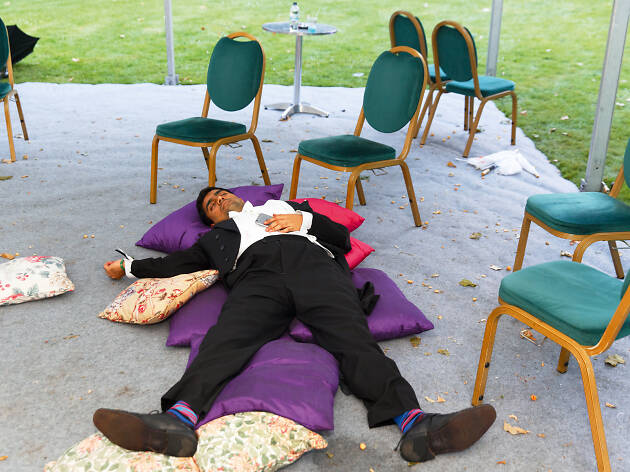
Parr has an ability to display the world in a way that displays all its fur balls and cliches right front and centre. I have always appreciated the honesty. The photography of Britain looks like the Britain I live in. Some would argue that the photography searches out levels of indignity and cynically highlights aspects of life that make us cringe. It was therefore good to hear an acceptance of this and an attitude that is prepared to not shy away from life as is seen. I asked if the strength of pathos us entirely deliberate at which point Martin confirmed that it is entirely deliberate “Humour is everywhere, people are amusing”. Martin elaborated that from early in his life he observed and appreciated the humour of Tony Hancock who’s humour was carefully balanced with an air of vulnerability, this was a vital moment in Parr’s interpretation of the British Public. Capturing the vulnerability of individuals is the tightrope that Parr continually crosses forcing the viewer to be amused, sympathetic or even appalled, depending on your viewpoint.
I found that listening to Martin Parr provided a pivotal moment for me. Rarely do you get the opportunity to hear from the actual artist and generally have to gain second hand interpretations from ardent followers or critics. To hear that most, (if not all) of my assumptions about Parrs work confirmed as being entirely deliberate came as a real positive as far as my own development was concerned. Many artists hide behind contextual interpretations and are often reluctant to provide clarity as to the ‘why’ and then appear ruffled if the audience view does not replicate their own.
It was interesting to hear Parr’s take on subjectivity. During early photographic practice, Parr noticed the very different feel he could gain by changing timings and light of the same scene. This became a telling factor in his early monochrome prints where weather had a determining factor and opened up the question about how true an image can actually be. What was interesting is that Parr took this view as an understanding of power within his work and developed a strong sense of responsibility whilst being aware of the capacity to influence. I have since read that Parr feels that photography is not designed to change situations, but has the ability to ask questions.
The early work (The non conformists) is a area of Parrs work that I had not previously come across. I have since viewed many of the photograph online. The title, I find extraordinarily good as is backed up by a much more gentle and accepting view of Hebden Bridge in the 1970’s where the strive for modernity had yet to be embraced. The black and white images aid the affable and tender nature of the collection. although Parrs ability to be whimsical still stands out.
Moving to colour changed aspects of Parr’s work. The subjects were portrayed in a more coarse style which became boosted by the unsubtle use of colour within the surroundings. However, as Martin Parr described, the change to colour illustrated reality well and did not make his work less relevant or honest.
Thanks to Amano for arranging the OCA event.
From my notes I summarised the following
- Parr has a love hate relationship with the UK as is not afraid to display this visually
- The humour and pathos is entirely deliberate
- Parr seeks out the cliches and is accepting of criticism of doing so
- The vulnerability of his subjects can be interpreted in many ways
- Parr’s Backgound was not from areas of society that he photographs
- Humour can not be avoided. To do so is not being honest
- Cliches are part of reality
- Parr avoids eye contact when photographing his subjects
- If enough frames are taken the subjects start not to notice the presence of a camera so much
- Martin Parr takes a lot of Frames
- Photographers mentioned in the talk – Peter Mitchell / Toby Ray Jones
 Gerard Hilderly Level 3 OCA