Portraits of Hope and Resilience
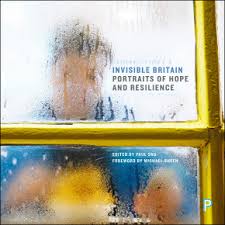
The premise of this book is to illustrate a level of truth behind those whose lives go unnoticed and feel unable to voice their social situation to the rest of society because society is not listening.
I became interested in this book having seen that their was a collaboration of photographers involved and a substantial level of text to accompany the visual imagery. The book itself is extremely clear as to its relevance to parts of the UK where where rising levels of individuals and families are finding things slipping away with diminishing support and little cohesion.
The degree of text within the book was significant to me as I have spoken recently with my tutor with regards to the accompaniment of text to provide greater depth in my work.
The accompanying words within Invisible Britain are highly poignant as they tell a contextual narrative from the subjects themselves and elevate the photography by providing a walk through the feelings, emotions and wishes of the subjects.
The descriptive text allows a compelling view of the subjects world and contributes to the levels personal distress and dissapointment with state assistance. I noted that the text – photography over two adjacent pages lends itself to curiously observing the subject prior to reading the text and second guessing aspects of the subjects whilst pondering as to the photographers intent. Once the text had been read, it is natural to re-visit the subjects image and apply the new contextual information. I found the changes were worth noting in a selection of cases.
Billy McMilan

The Photograph takes on a feeling of resignation and alienation. The gaze towards the clouds initially suggested an appeal for help amongst a backdrop of a baron landscape
The text provides a strong sense of decline and remoteness. A new town that has been used as an exercise in planning with an objective to eradicate the poor areas of Central Glasgow by annexing a bright future for the inhabitants seven miles away.
By providing a real sense of Isolation the photograph takes of a stronger meaning. Easterhouse has survived the effects of underfunded urbanisation where physical communal links were relatively thin leaving a suburb detached from its parent town and yet with similar social issues to that of the previous environment.
The gaze to the clouds reveals further understanding when reading the subjects ambitions of hope. Maybe the gaze is one of hope rather than dejection and that the need to dream is being perpetuated by the horizontal body language and cinematic visual.
Marie McCormack

Marie and daughter Olivia have a very different gaze towards the lens. Marie appears pensive and chooses to look towards the floor whilst her daughter depicts a more inquisitive stare. The red curtains give escalation of passive anger.
Photographer Margaret Mitchell
Compelled to not stand still and suffer the consequences of poverty, Maria formed the Poverty Truth commission. The expectation for a better life for her child was slipping away as society became more divided, leaving the ‘have not’s’ to go without.
The struggles that Maria had with bureaucracy to stay afloat proved stressful to the point that pride and security were being eroded for the family unit.
The image displays a connection between mother and daughter that may appear fractured at first. However, the text provides more of an insight into a mothers desire to provide opportunities for her son and daughter. The stress and affects of stress to accomplish this are evident, whilst the level of compassion for others in similar circurmstances remains evident
 Gerard Hilderly Level 3 OCA