Within the period of the course, there have been many poignant step changes that I can reflect upon. The point where my practice ventured into new territory was primarily a reaction to the logistical constraints of photographing during a pandemic. Not only had I stopped working at St Mungo’s recovery college, ( where my photographic subjects had agreed to be portrayed to display the damaging affects of homelessness), but the streets were relatively empty and visual normality had shifted. After lockdown, my own health dictated that I could no longer put myself at risk and therefore continued with the OCA ‘Keeping the momentum’ gathering of artistic minds. I was struck by how creative the group were and realised that my own creativity was always attached to reality and the literal view.
Puppet Constructions
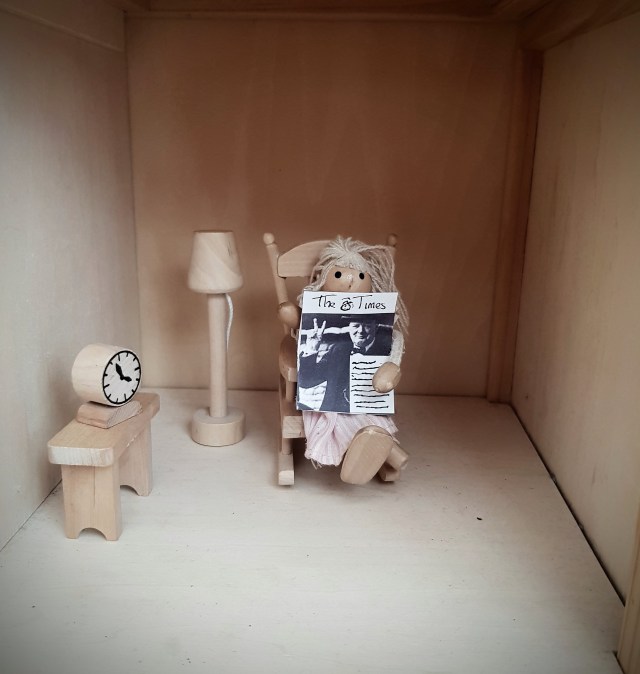
The elevation of a tableau style approach, using puppets during lockdown produced some telling visual examples of how I could elevate and transfer meaning. The contextual elements of my photography had always been too complex and multi layered, The manipulation of artificial subjects, released a new found desire to throw up previous attempts to photograph relatively straight and go beyond the comfort and security of representing a one dimensional visual that was trying to do too much. I also became interested in the power of the media and descriptions of ‘how things are’ and ‘how they should be’ filtering down to be accepted as objective truth. My subjective thought could be projected by adding elements that don’t belong, throwing the culture of hegemony to one side and opening avenues of thought through visual constructions
By adding physical elements that appear out of place, I found a method of symbolising the overarching power I had been trying to visually represent.
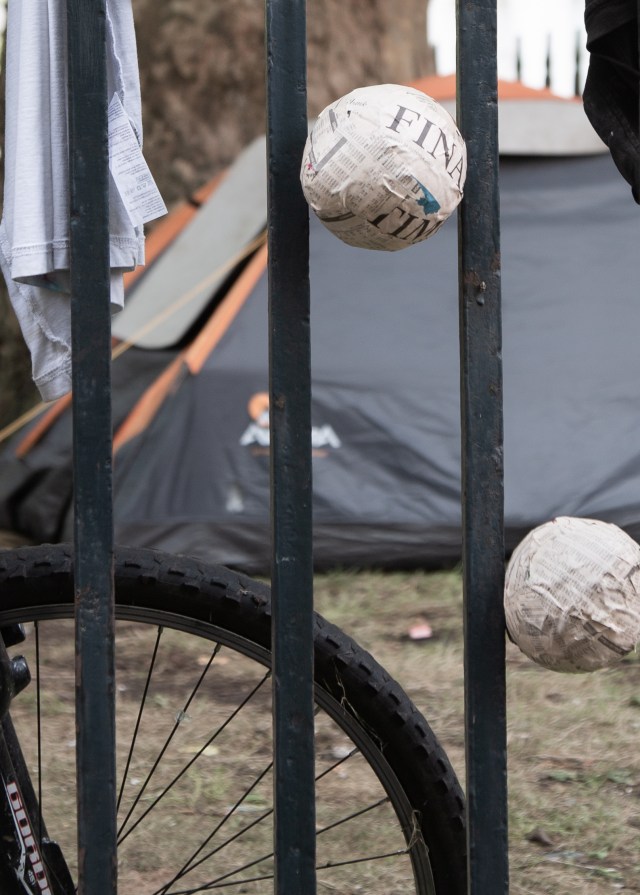
By transferring the element of power (in this case financial power) I also found a method that removed the identity of the subject. This had been an area I had looked into from the research of Stuart Hall and Martha Rosler. I could Identify a presence of homelessness and relate to the causation of power, as seen through the early workings of the concept.
Development of Photographic Body of work
The restrictions during the Pandemic created a complication with regards to photographing my intended subjects in 2020/21. The practice of representing a level of inequality through a highly interactive form of social documentary requires a level of engagement and social contact. The logistics required a risk to both myself and my subjects. As a result, after much thought, it became obvious that a new direction needed to be adopted if I were to complete the Body of Work.
Work on developing a form of photographic practice (in a form that could be sustained even under restrictive conditions) provided a number of obstacles. However, previous research into the work of Martha Rosler’s ‘The Bowery in Two Inadequate Descriptive Systems’ helped inform the development of a creative process that represents a damaged existence, without portraying the actual victims.
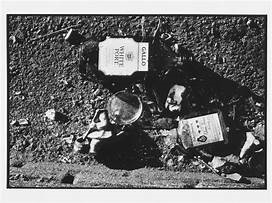
The driving force was to maintain a level of photography that remains within the realms of social documentary, although the meaning will be expressed via an artificial element that acts as a signifier for a conceptual meaning. Reality needs to be evident and encompass the majority of the meaning whilst my artistic interventions adds a conceptual juxtaposition in the absence of any human presence.
Physical objects that represent an unequal balance will provide the juxtoposition. These will take the form of signifiers representing the establishment by means of a bowler hat, FT etc.. How I relate and connect the items within the frame will be part of the process I am undergoing. There will be a number of choices which could be formed in my minds eye, although I have always felt comfortable making artistic decision’s whilst in the moment….
Practicalities and considerations for photographic practice
Much thought and consideration has taken place to firstly, think about the direction of my Body of Work and secondly, to think about the practicalities, given that the level of freedom to photograph is unknown at present. There is also the consideration that the subjects that were available to me, are now restricted and photographing life as it was three months ago, is now a very different concept. Maybe I should take this into account and explore the aspects of inequality within a restricted social environment.
The aspect of the pandemic crisis that is a developing certainty is the increasing number of families and individuals whose lives will be economically more precarious as a result of a looking downturn in the UK’s finances. The numbers being quoted could be catastrophic unless support from the bottom up is provided, whilst the demographic of the inequality gap could witness many people falling dramatically from the middle of the scale and into the lower end. I have often regarded this economic aspect visually and thought of how this looks today. The materialistic nature of society doesn’t necessarily display poverty in the way that could be portrayed in Victorian times, pre war, or 1970’s and my fear is that the increase of personal debt, lack of savings and a absence of hope could tip the scale into disturbing levels. ……..
Keeping up momentum
Reflections and direction of BOW
With the onset of COVID19, photographic practice has been difficult. Due to an accident with my left arm, I have been unable to use my a camera since Jan 2020. Physiotherapy has proved successful, but social distancing renders social documentary impossible. Not wishing to be deterred and to maintain momentum I have been observing and participating in other ways to keep alive the creative muscles in the brain having notoriously suffered from an inability to engage after a spell of neglect.
Amongst the OCA a group formed (not necessarily within photography) to continue practising with aim to producing interpretations of thoughts throughout the lockdown, Some of the work is collaborative and has been beneficial to see the development of ideas through the eyes of others. For my own part I have taken a view through the eyes of my 8 year old daughter to spark some creative processes.
The idea resonated with me after a homeschooling task evolved into representing people as dolls and placing in environments to display a narrative. The development of this took hold as I attempted to create scenes combining the rhetoric from the media into visual reality. I became concerned at the level of conversation referring to a war like effort with phrases such as ‘Dunkirk Spirit ect. What would this look like in a visual context knowing that the virus should be something to protect yourself from, rather than forcibly confront?

The result provided something quite dark and troublesome. There is an element of humour that is deliberate, but ultimately the attempt is to visually try and replicate language into actions.
Reflections on approaches to BOW
Embedding myself within a group was a decision taken to engage with the very situation the BOW is aimed at portraying. The group are students from a St Mungo’s recovery college in Bristol, many of whom are living in insecure circumstances and cannot gain meaningful employment. My role is to teach the basics of creative photography to release an imaginative are of their thought processes that in turn can release positive emotions and a small change in the daily routine.
From my part I have learnt a significant amount which has prompted a change in direction from my initial considerations, having witnessed the magnitude of a social problem and the increasing degree of relatively young adults getting lost in a system where the demand outweighs the support.
The benefit for my own development and understanding is substantial and I am committed to teaching at the Recovery College to continue the small release of positivity witnessed during the sessions. In terms of the Body of Work, I have had to consider a slight shift in direction as I have found myself struggling with the ethical consideration of photographing the lives of subjects who are more vulnerable than I had considered when developing my initial thoughts. The complexities and challenges of the very lives I am looking to detail provide an insight into the level of poverty and inequality gap. Although wary of highlighting an essence of otherness, the degree of health issues and complex needs amongst the very people I am looking to identify with, proved uncomfortable for me within the context of a student photographic project. For all the good I could do by humanising an increasingly escalating section of society, it felt as if I would be gaining consent from people who were in not in a comfortable position to do so. Not only would this feel unethical, it would also potentially effect my overarching narrative as the conscious moral considerations would eat away to the point that could potentially come across in the photography.
Determined that the central point of the BOW should remain, the pursuit of defining inequality within the UK remains key to the overriding project. The level of understanding and insight I have is proving advantageous to my creative thought processes. The key is to balance this with a visual narrative and contextualise the elements within the premise of the overarching body of work.
Reflection on approaches to BOW having completed Assignment 1
Throughout the course, I am prepared to accept that any approach I adopt may require rethinking or refinement.
Having worked on some photography for the first assignment, it is becoming apparent that connecting with subjects is paramount to producing something more telling and significant. The ethical considerations feel more comfortable having spent time discussing the subjects plight/story and providing the subject with some context to my own work (I will look at at the photographic benefits within Social Documentary Photographers)
The intention to forge greater connections is to embed myself with one or two aid orgabizations (Genesis Trust) where by means of a collaberativ effort, I can, over time, forge relationships and gain a greater understanding of the essense of someones story if they are comfortable to reveal. Investing in people is important to me;
For assignment one I channelled much of my thought processes through a defined point of action. I find that if I am actively involved with a cause or action that I am looking to change, the photography becomes more meaningful to the third person . Having this focuses the mind on highlighting a micro -element of a wider situation and aids with providing readable meaning (something I have struggled with in the past).
Intimacy and presence within the photography is an area that has evaded some of my previous work. A discussion with my tutor gave me the impetus to take more photographs and get closer. observe other photographers and understand the subject you are portraying.
The decision to work with a local group in Bath was taken to further expose myself to the lives of those I am looking to photograph. The deeper I look into the issues around social inequality and the effects upon a growing section of society, the more intimate the photography. That is the theory and my current approach.
Initial Thoughts Prior to commencing BOW
To objectively understand the varying degrees of considerations within social documentary photography, it has been necessary to firstly view my own practices when photographing subjects who find themselves in circumstances where exploitation of their identity could be seen as crossing ethical barriers.
The primary objective is to capture the truth and reality with sincere honesty. The photography is undertaken without any intentional endangering, exploiting or subverting the subjects personal welfare.
How accurate and honest I can be will always be a consideration for the viewer. However, I have always felt much weight on the subjects reliance on the photographers intention and convictions to remain true to the scene presented in front of the lens. Presenting an image from an angle can determine a highly different perception of a scene than the actual reality and the I feel a moral responsibility to the subjects to not skew the context for a opportunity to subvert the context.
Research on this area has led me to approach subjects with my intentions in the forefront of my mind. Susan Sontag produced a array of dangers that can promote the photographer in a good light, leaving the circumstances of those being photographed in peril. Although there are aspects of Susan Sontag’s concerns on photographers moral codes that are open to debate, I often find myself repeating aspects of Sontag’s later work in Regarding The Pain of Others “Photographs objectify: they turn an event or a person into something that can be possessed.”
― Susan Sontag,
Objectification can be deemed a term of dehumanisation. It is this area that I have challenged myself on by reflecting upon my intent which I feel is almost the opposite of dehumanisation, but the quote from Sontag is constantly in my head whilst photographing.
Intent
The visual information should provide both meaning and an element of my own personal thoughts. By choosing to photograph subjects who could be seen as abandoned by society, it is my intention to explore the many aspects of putting yourself in the presence of hundreds of others.
Many who find themseves in times of extreme hardship place themselves in crowded, highly populated areas as a way of surviving the day. More opportunity’s arise, and to achieve this many have to be omnipresent. The presence of a camera is one more casting eye and easy to give consent for the oppotunity of a chat or a donation. By being aware of this circumstance, the intention has to be provided to the subject, whilst a truthful representation in gained.
Identification is not the sole aim. The ethical considerations are constantly present while I attempt to balance this with the aim of displaying an intimacy fuelled by empathy for the subjects plight.
Otherness
Having re-read On Photography and Regarding the pain of others, I am increasingly conscious of the power that could be interpreted within my work. The unconscious power is also an area of concern and is sphere of social documentary photography that required more research on my part.
Photographing the contrast between those in hardship against a backdrop of very opposing lives could be seen as promoting the visual aspects of otherness. The subjects stand out and are significantly highlighted as different. This could easily be coded as a display of power from the photographers perspective and a gaze through the prism of affluence.
Gaining Consent
Personal consideration and judgements need to be made that consent to photograph may be given as this is sometimes easier than declining, especially if time has been taken to forge a conversation.
During some early photography, previous work was shown to subjects and my intentions were given where upon the consideration is discussed of not identifying the subject visually or narrowed the focus.
 Gerard Hilderly Level 3 OCA