The Work of Art in the Age of the Mechanical Reproduction
Walter Benjamin
In viewing the essay my primary observation is to consider the form of a photograph as a reproduction. The understanding of the concept of a mechanical reproduction in 1936 has been through many levels of conjecture to the point that it sounds a little odd to refer to a twentieth century art form as mechanical. If the view of a photograph is the result of an automated process, then much of the subjective nature aligned with the individual creativity, becomes diluted. From reading the Walter Benjemins essay, it appears that this is not necessarily the case and the concern over the mechanical influx of photography, is to prevent the loss of presence and aura.
A recent assignment I submitted from an earlier course in a suburb of Bristol displayed much of the individual style and aura of the local environment. As part of the feedback I received was the opinion that I could be using other peoples art and replicating this rather than my own thoughts.

The original artwork in this case creates an aura that I have attempted to portray to display the essence and character of a highly individual area of Bristol. By taking in a deliberately subjective way I have chosen to use the original art to identify with the aura of a place which refers to the creative identity and rebellious spirit. It could be argued that I was attempting to borrow the original aura of the artwork and create a representation that encapsulates a wider view of the very thing Benjimin suggests that reproduction dilutes.
The aura that Benjamin refers to the original historic experience and the manner in which this is reduced over time when reproduced. Having read the same passage a few times, I am still rather perplexed as to whether the aura withers due to a form of copy from an authentic piece, or as Susan Sontag and Kracauer suggest, the over representation of the same view.
The acknowledgement of the subjective view further perplexed my thoughts on the essay, as it appears to accept that the ‘Photographers will’ has a determining factor and therefore appears to challenge the notion of a mechanical representation (this may be my own understanding that finds this view in opposition to the central point).
When reading Benjimins acceptance that mechanical representation has the ability to adjust the lens, and angle in such a way that is impossible to replicate with the human eye, I find myself asking, are these decisions not taken to create something personal and original?.
Benjimin gives a strong understanding (the example used is the ancient statue of venus) of the original artists thoughts and motivations which could be guided by a sense of ritual. The original is conceived to have a presence in time and space and a unique place within a historic context. With this in mind, I concur than all the for-mentioned elements add to an aura if the historic understanding is known, although I still struggle a little to see how a reproduction necessarily lacks the same presence. A poor reproduction will generally suffer as a consequence of the copy label, but photography is able to present so many varying views that the slightest differences take on an impression unalike the original.
The acceptance of a camera’s capabilities appears to soften the view of a reproduction who’s value is diminished as a result of the lack of authenticity. The value Benjimin gives to photography is provided in its capacity to challenge our view by means of close ups, movement and enlargements.
Overall, this is not the easiest piece of written work to comprehend. I have read elsewhere that Benjamin is accepting of of photography’s ability to produce aura within the boundaries of an authentic representation and that he retained the foresight to see photography as a mechanism for future good. I very much concur that art provides a aura in some circumstances. A photograph of a piece of compelling art reproduced in a magazine or book has almost certainly far less aura than the sizeable piece hanging in a gallery designed to extract feelings and impress. I do however feel that it is too easy to diminish the aura of a copy if that is all you have to your disposal.
By protecting the authenticity of an original, Benjamin displays some credit. It is a reaction we see today when technical advancements appear to be diluting a much appreciated form. It is difficult to assume if this was the authors prime objective as there is a level of appreciation for the photographic representation and Modernism stems from the forging ahead with new ideas.
The Photographic Activity of Postmodernism – Douglas Crimp
By observing the view of Douglas Crimp, the understanding of presence within art becomes significantly clearer. This may be aided by the style of writing which is a little more engaging and colourful than the Walter Benjamin piece,
By quoting Benjamin, Crimp appears to place the modernism on a self awarded pedestal and assumes that Post Modernism does not suffer the same lure of self regard. Artists are suggested to not seek acknowledgement for their work. The hybrid representations will be formulated and presented whether the viewer is appreciative or not and the artists will not get bogged down with the positives and negatives of the reception.
I remember covering this aspect with studying the New Topographers and found the concept slightly at odds with natural human instincts. There was certainly a view that the artists wished to remove themselves from the presence of the representations and deliver in a way that is seen as non judgemental. This prompted further thought with regards to Postmodernism, as there is an air of standing back from art and not wishing opinion to affect your personal standing. I remember at the time thinking that this was entirely possible as an individual who bears this trait. For a collective, movement or culture to be able to adopt this stance, it would surely be a choice which many would like to be seen adopt, rather than have the innate power to achieve.
The presence that Crimp refers to is explained well by use of a Henry James novel and that drama that is felt when an absence (ghost) provokes a feeling of presence. It is entirely understandable that ‘being there’ provides an experience from viewers perspective that is difficult to replicate, especially when observing performance art or an art installation. The presence within Photography and paintings are deliberately elevated by size and environment, although publications, books and digital media achieve the role of providing volume to a wider society. Replications of artistic work are often of extremely high quality, especially in book form. The presence of the artist can often be witnessed in this form and a level of aura can be found, depending on your level of imagination. Authenticity holds the upper hand and if copied and represented in a diluted from, the received presence and aura will suffer.
The presence defined by Crimp is explained as something different to aura. The aura detailed in Walter Benjamin’s writing is predominantly about the authenticity of the original. Crimp sees this as separate to presence which is provided by postmodernist photography where absence is defined by a deliberate feel of non inclusion, represented by providing a distance from the original. The work of Jack Goldstein has been used to provide context to the idea.
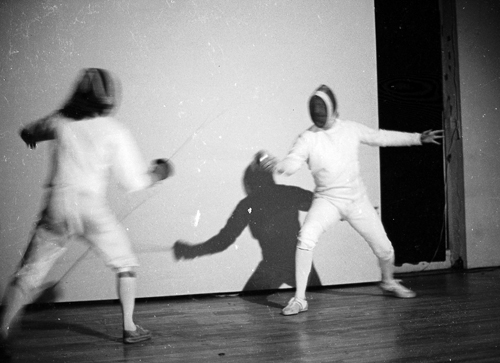
Jack Goldstein. Two Fencers
Elements of this photograph provide a deliberate elevation of the overall feel of absence. The distance, lack of identity and silhouette elevate the feel that you are observing s scene that you are remote from.
Douglas Crimp relates Benjamin attempts to only see presence in early photography by comparing to a painter whose hand is undoubtedly present in the scene. An early photographer who had to spend time composing with long exposures and the constraints of movement could achieve a level of presence by containing the uncontrollable illusion of reality. Whilst more contemporary work failed to reach this magical quality. It is difficult to relate to the central point within Benjamin’s work as in both the writing and concept, it is possible to detect an air of snobbery. The element of aura holds a degree of value to argue against within the realms of an almost innate human trait for authenticity and a reluctance to accept a culture that lessens the importance of the original. This is highlighted by Crimp who identifies the choices made by museums and galleries in the early 1970’s where historic pieces were being excavated from store rooms to populate classical rooms. I remember as a child being taken to such rooms in the early 70’s which had a overriding feel of historic value, coupled with a degree of stuffiness and monotony. Crimp suggests that a definite change in this philosophy during the mid 70’s, (the era when postmodernism was becoming part of social culture) as a revival in expressionist art was gaining traction and photography was being viewed as a serious art form.
It is worth considering how photographers considered their work during the years that led to more Postmodernist values. Did they see themselves as a product of an art form trying to compete with the weight and wealth of other more accepted artistic mediums and felt the need to imitate as a method of respectability or was it the wholesale concept of a mechanical representation that could not be seen as authentic, whatever the interpretation. Certainly there is much evidence of photographers pushing the boundaries beyond formality or classical ideaoligy in their work. Benjamin indeed, witnessed the value in the work of Eugene Atget but described the ’emptiness’ as the reason for the lack of aura and added that Atget “initiated the liberation of the object from the aura, which is the most incontestable achievement of the recent school of photography”.
Acceptance of photographic representations in the walls of art gallerias criticism brought about a tussle for recognition and space within the art world. Photographers, prompted by an new found attitude appear comfortable to openly advertise the level of subjectivity within their work. Crimp considered the level of subjectivity within photography and quoted that “At the origin of each there is an Artist, and therefore each can find its place on the spectrum of subjectivity.”
In terms of Postmodernist understanding, upon the acceptance of photography as an art. I find the consideration of acceptance a strange value, given my understanding of postmodernism. If mechanical representations continue to suffer from inclusion within the world of art, did the postmodernists display uneasiness in this area?. Having a voice, and being represented in areas alongside paintings and sculptures surely evokes the very reactionary development that was being sought. Whether an aura is transferable from a mechanical representation or a paint brush could also be a cultural view (easier to accept in 2019 than 1970). Our acceptance of art, and how we read it, should come from a personal reaction driven by our experience, consciousness and visual motor responses. That in iteslf maybe a cultural understanding.
Crimp acknowledges the contribution to postmodernist photography from Cindy Sherman, and offers up words that fulfil the postmodernist concept such as subvert and displace. Sherman’s photography is designed to represent a reality within a reality and deliberately subverts any level of objectivity. If an aura is displaced as Crimp suggests, it is designed to be challenging of the stereotypes represented before. In Sherman,s case it was the stereotypical assumptions of femininity that were being challenged via a view of self, within an artificial drama. The presence is again shown as a type of absence. The photographer is there in the frame, but is not there. This level of postmodernism conjures up a number of debates as to how to interpret the level of subjectivity which I have always found fascinating. Not necessarily the debate itself, but rather the need for clarity. Walter Benjamin appears to define clarity and answers and I fear that postmodernist, by its very nature is designed to make matters more ambiguous.
Allan Sekula Reading and Archive: photography between labour and capital
This article by Allan Sekula became something I felt compelled to read twice, not because of the need to comprehend, but to double check what I had just read. The premise of the article, focuses on economic conditions, ownership and power. This direction, I find illuminating and a much broader view upon our understanding of the original intention of a photograph, the overriding contextual reasons for photography and the complexities of projecting, owning and selling the work of others.
Aspects within the articles by Crimp and Benjamin I found to be a little dry. The exploration of mechanical representations is perplexing to a point and divides thought between the intended meaning and authenticity. Sekula appears to observe the division with culture as more of a change over time and places more emphasis on the loss of context within a photograph rather than the loss of authenticity from an original.
There is an acceptance that Archives are property and constitute a territory of images. I like the use of the phrase territory. It assumes that ownership is a prominent factor and assumes that photography is no different from painting or sculpture in terms of the creator having an investment in a work. Sekula relates this to economics as his understanding attempts to untangle the relationship between photographic culture and economic life. This to me meanders the conversation towards power and influence. Once economics becomes a driving force, the objectivity of purpose can be questioned from the outside.
The power of ownership takes a different shift when catalogue of work owned by an individual other than the owner. The work can be subject to the danger of misrepresentation or plain misunderstanding. Books that are used as a vehicle to display a collection of work rely heavily upon the viewers interpretation when observing a collection as a whole. Sekula refers to the reproduction of historical photography as a method of portraying ideas that ‘lean heavily on photographic realism’. I would concur with these thoughts as dissecting a historical photograph for its original intentions is a more difficult practice when time has lapsed and culture has moved on. Sekula refers to the visual ‘appearance of history’ and the use an accompanying photograph, which can be carefully selected as an interpretation of the past.
The use of historical photography, used to reinforce historical text for learning purposes is often reinforced by the presence of a photograph showing how things really were. Sekula states that such use of imagery should be witnessed with caution. The photography is presented regardless of the objectivity of the coupling between text and visual image and a disregard for potential bias within a historical image.
I find this statement an intriguing central point within the context of the essay. The acceptance of a blurring of the original interpretation of the photograph and the potential disregard for the purpose in which it was designed. There is a similarity in Sekula’s suggestions to that of the 18th century painters commissioned to portray an individual in a certain light to hang within the confines of the subjects own private estate. Paintings always appear to have a level of accepted commentary that discusses the context in which it was commissioned. The truth within photography is dissected, but only really from an academic point of view. Generally the rationale behind why a photograph was taken in historical terms is secondary to the actual historical elements of a considered truthful representation. This leads on to the willing acceptance of historical photography and how it is unconsciously and consciously possible to mislead.
Sekula uses the pictorial information from a post war mining town where photographs from a company PR archive are used to historically give visual evidence to excavation during the 1950’s. The point is highly valid as no information is provided to explain the bias for displaying conditions in a certain way. This can be replicated in many WW1 photographs where Military Photographers were used to capture scenes of high spirits away from the front lines. These representations are still being used today as little non staged photography from trench warfare was taken between 1914 – 18 and therefore text books would display a very different war to that experienced by our Great Grandfathers.
The essay continues to discuss the position of the viewer and the effect of witnessing a catalogue of historical images connected loosely, but designed to visually accompany text. Sekula describes this to be like being flung into a condition of imaginary temporal and geographical mobility (a disoriented state ). The photography in historical text books is provided without critical examination and therefore assume the position of accurate historical representations that prove to be an aesthetic experience
.
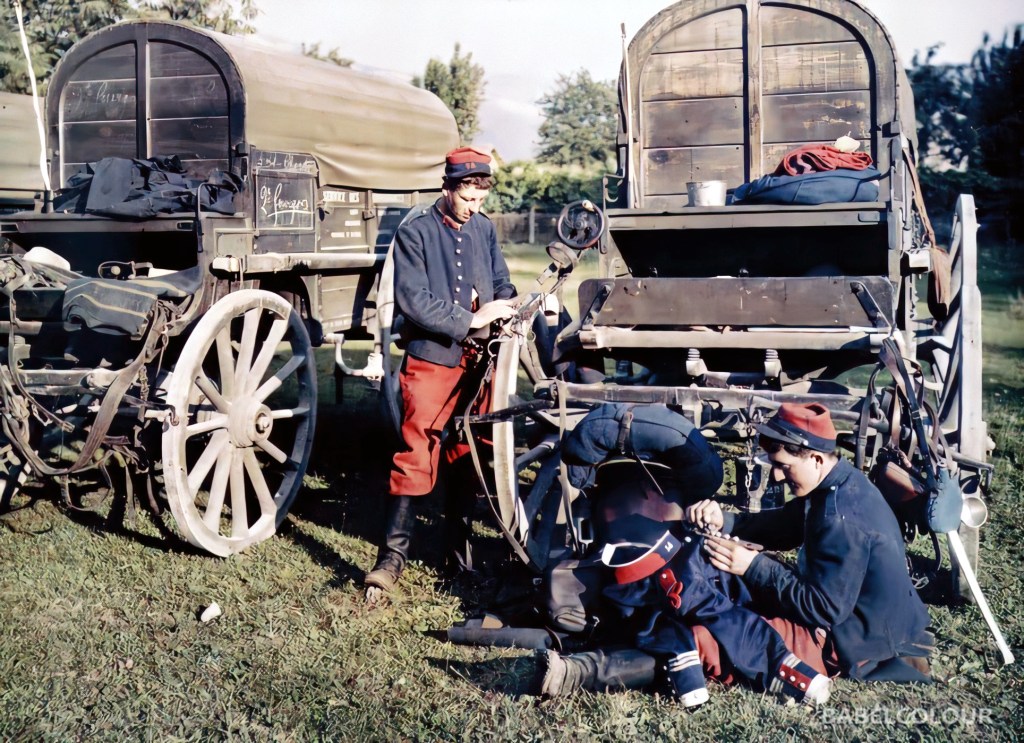
– 1914 The pride of French military look out of step with twentieth century warfare
The understanding of aesthetic experience replaces logical argument. However Sekula also views the experience of minimising explanation of historical context in favour of viewing the photography as a work of art. I can only assume that the author is playing devils advocate here. Sekula does reference this way of viewing as ‘absurd’ but in doing so, provides food for thought. By removing the initial context of an image, all you are left with is art.
The relevance of the historical photography being viewed cannot be dismissed. Sekula succumbs to the notion that viewing the work of one photographer provides an easier way to understand the initial intent. The authorship creates an easier transmission of context and provides more clarity to understanding the visual connections. Coupling photographs from an archive from a third party can dilute and devalue the contextual historical relationship.
Sekula discusses the perception of photography and managies to split the experience into two categories. Viewing objectively in search of truth and viewing subjectively to gain a more romantic quality. I find this divide compelling, as it walks the very tightrope experienced within my own development. In attempting to portray objective situations, I also remain true to my subjective thought processes. A representation can be truthful, but as the photographer sees it, within the realms of his or her own unconscious and conscious bias. To accept that a viewer is able to balance the two positions is part of the appeal or dilemma, depending on how accommodating you are about the two positions. This may well be a level of inconsistency that gives photography a historic complicated categorisation within the world of art. As a student photographer, I find this area particularly engaging to comprehend and less helpful whilst in practice. The thoughts that balance the level of realism and aesthetic vision combined with the objective truth and subjective experience can compress one area in favour of the other. It can be more beneficial in my opinion to be aware of the dilemma without weighing yourself down to the point that your work becomes too rigid or ambiguous. As the course progresses, I will detail further thoughts and developments within this area
Allan Sekula suggests that their is a link between the mechanism and subjectivity “Preserving the moment of creative autonomy that is systeamatically denied in the rest of most peoples lives”. By using the term autonomy, the author is referring to power and relates this to class attitudes of photographic art that can be steeped in pretension and pomposity. Industrial and commercial photography has a level of aesthetics (Sekula calls this the aesthetics of power) and if not always apparent at first, further consideration will usually display a degree of subtext derived from power. My interpretation of this scenario can be witnessed in Bill Brandts Parlourmaid and under parlourmaid where the subjects gaze appears steeped in hierarchic attitudes, subservience and possibly fear. I have often wondered about institutionalised representations of reality. The very nature of the situation is often engulfed in layers of historic power and subservience. The Brandt photograph may well be an extreme version of such a phenomenon, but its a visually descriptive portrayal of control

Having found many aspects with Alan Sekula’s essay which have prompted further thinking on my part. I will endeavour to search out other written articles. Photography against the grain has been recommended by my tutor.
Photography in the global age
When observing the concept of globalisation, I find myself more often than not caught between upholding Internationalist alliances in opposition to Isolationism and Nationalism, whilst decrying the effects of cheap labour, low wages and the flight of industry and manufacturing. Globalisation feels like an unstoppable force with little concern of the consequences, many of which are visual and stark in appearance.
The visual representation concerned with the effects of globalisation mainly focuses on the fall out or cost of win- win alliances. where consideration for the over-spill of success is rarely written into the original agenda. Much of the cost becomes apparent long after the benefits have been sucked up and remedies are often too little and too late.
The negatives are much publicised and often cloud over the cross cultural developments and, technological advancements that provide a force for good in many areas, including education. The ability to share knowledge across diverse societies installs hope and provides comfort that the human race is capable of displaying intertwined reactions that reinforce learning and development through the immediacy of shared content Communication, feedback, guidance and understanding can all be obtained without the need to be confined to an institution. However, the pitfalls cannot be ignored and in some cases are wide enough to negate the benefits. It is entirely plausible to sustain the positives without feeding the destructive elements to such a degree, many of which are driven by greed, power and a distinct lack of consideration for other factors.
I have often wondered why this should be the case, and have thought about the possibility of distance being an underlying factor. If people, nature or other economies elsewhere are struggling as a direct result of your (or your companies) actions, does the very nature of their struggle not being situated on your doorstep, enhance the lack of empathy.
Photographers such as Edward Bertinsky and Sabastiao Salgado have famously created visual references to the erosion of the land and exploitation of cheap labour. There is beauty in their visual documentation of something that is deeply troubling. The aesthetics can lure you in to a world that could be on the precipice of a catastrophic second half of the century, all within a display of alluring symmetry, stark poignancy to provide a tale of man’s ability to destruct for profit.
Much as I enjoy observing these large illuminating creations, I feel that they are almost too grand, Sumptuous and other worldly. I understand that the photographers intent was to provide a strong undercurrent of political purpose and its unquestionable that the contextual understanding pours out, but does the beauty dilute the message, and does the sheer artistry gain an unbelievable quality? I am never completely sure, although I often feel confused at the dichotomy and I’m sure this was never the artists intention.
The consideration of photography depicting issues of a global age appears in less grandeur by artisit Chris Jordan, https://www.artworksforchange.org/portfolio/chris-jordan// who provides a close connection to his subject by depicting the small acts of mass consumption which have an impact upon the wider global scale.

Jordan uses the beneficial aspects of the global age to project his visual questions from one continent to another in seconds. There is a level of irony that this very shrinking of the globe can be used for accessibility and speed to elevate perspective of global mass consumerism. The photography artistry appears to focus more on elements of destruction that have greater impact elsewhere. By photographing contextually this way, the work treads the line between art and sustainability in a similar way to that of Edward Burtynsky. The difference that I see however is apparent in the connectivity. This may be down to the closeness, chosen subjects or the use of everyday objects and scenes that stand out as unimportant, until you look closer. Large scale drama depicting the earths changing form from the view of a helicopter or location that is beyond my limits creates a level of detachment, although I do appreciate the highly creative and important political context.
 Gerard Hilderly Level 3 OCA